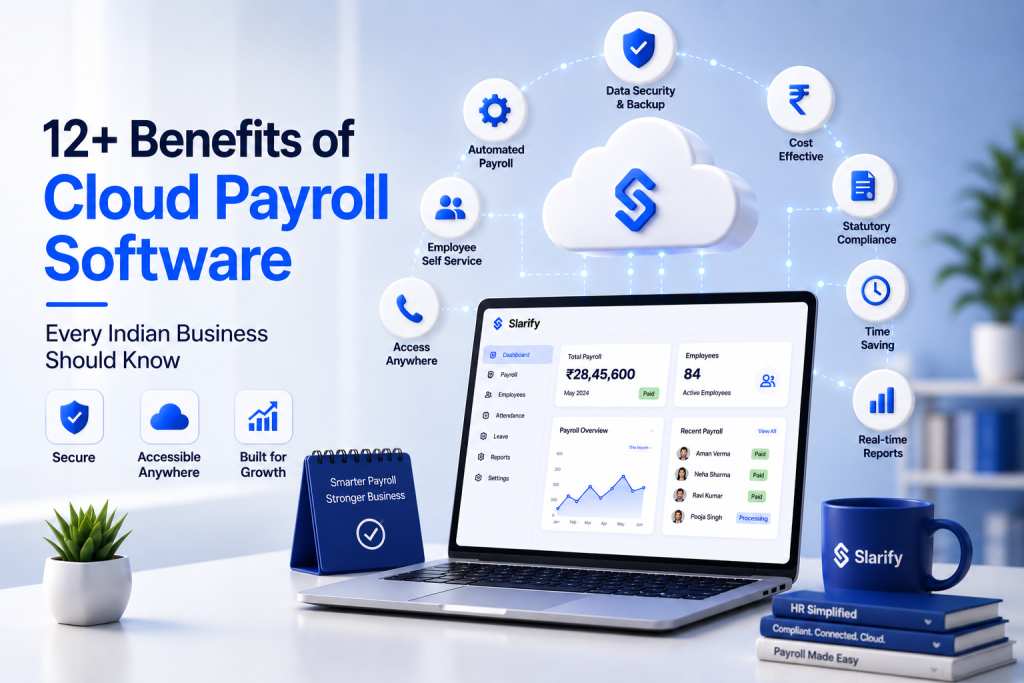
Here is something every HR manager in India knows but rarely says out loud payroll week is the most stressful week of the month. Attendance data is missing, someone’s salary structure changed mid-month, the accounts team is asking for numbers you have not compiled yet, and there is a compliance deadline quietly sneaking up on you.
Now multiply that by twelve months. That is a lot of pressure for something that should, by now, be running on its own.
The good news is it can. Cloud payroll software has made it entirely possible for businesses of all sizes to process accurate, compliant payroll without the monthly drama. And Indian businesses, from small firms in Kolkata to large corporates running multi-state operations, are increasingly waking up to just how much this technology can change things.
In this guide, we cover everything what cloud-based payroll actually means, all the benefits you should know about, how it stacks up against manual payroll, and what to look for before you choose a provider.
What Is Cloud-Based Payroll Software?
Cloud-based payroll software is an online platform that manages your entire payroll process salary calculations, statutory deductions, payslip generation, compliance filings, and more through a secure internet connection. Unlike desktop software installed on one office machine, everything runs on remote servers that you access through a browser or app, from any device, anywhere.
There is nothing to install. No local server to maintain. No IT team needed just to keep things running. The software provider handles infrastructure, security, and updates in the background while you simply log in and get to work.
For Indian businesses dealing with multi-state compliance, varying salary structures, and monthly statutory deadlines, this kind of system is not a luxury it is quickly becoming a necessity.
Quick distinction: Automated payroll software refers to how the system processes payroll automatically, without manual inputs each cycle. Cloud is where it lives online, accessible, and always updated. Most modern platforms are both.
12+ Benefits of Cloud Payroll Software Explained Simply
Let us get into the details. These are not just theoretical advantages these are the real differences businesses notice once they make the switch.
1 Centralized Employee Data
Employee information scattered across emails, spreadsheets, and paper files is one of the most common and most quietly damaging inefficiencies in Indian HR teams. When payroll data, attendance records, leave history, and tax information all live in different places, mistakes are inevitable and finding anything takes forever.
Cloud payroll software brings everything under one roof. Every employee’s profile, salary structure, documents, and history sits in a single, organized system. The right people can access what they need instantly, and everything stays in sync without any manual reconciliation.
2 Reduced Payroll Costs
This one surprises people. Software feels like an added expense, but the reality is that manual payroll has a lot of hidden costs extra staff hours, error corrections, physical storage, IT maintenance, and compliance penalties when things go wrong.
Cloud payroll software replaces most of that with a simple, predictable subscription. No server rooms. Hardware upgrades not required. No dedicated IT personnel. For small and medium businesses especially, this shift from unpredictable high costs to a flat monthly fee is a genuine financial relief.
3 Simplified Compliance and Adherence to Regulatory Rules
Indian payroll compliance is genuinely complex. PF, ESI, professional tax, TDS, labour welfare fund the rules differ by state, change periodically, and carry real penalties if you get them wrong. Staying on top of all this manually is a full-time job in itself.
Cloud payroll software auto-applies the latest statutory rules to every salary run. When regulations change and they do, often the system updates in the background so your calculations remain accurate without you having to track every government notification. Statutory reports and challans are generated correctly and on time, every month.
This is not just a convenience. For any business that has faced a compliance notice or penalty, it is a genuine business risk reducer.
“Compliance used to take up a week of my time every quarter. Now the reports are just there, ready to file.”
4 Payroll Automation and Reduced Workload
The monthly payroll cycle pulling attendance, calculating salaries, applying deductions, generating payslips, preparing bank files is repetitive, time-consuming, and high-stakes. One wrong formula in a spreadsheet can ripple through every calculation below it.
Automated payroll software handles all of this systematically. Attendance syncs in, salary components apply automatically, deductions calculate, payslips generate, and bank transfer files are ready for approval all without your HR team having to rebuild the process from zero every month. The result is fewer errors, faster turnaround, and a payroll team that finally has time to focus on people instead of numbers.
5 Automatic Updates and Maintenance
With traditional software, updates are a project. Someone has to download them, test them, install them and hope nothing breaks. Many businesses simply delay updates, which means running on outdated compliance rules without realizing it.
Cloud payroll platforms update themselves, silently, in the background. When a new PF notification comes in or a tax rule changes mid-year, the system adapts before your next payroll run. You log in and everything is already current. No action needed on your end.
6 Scalable and Flexible Payroll Infrastructure
Growing businesses need systems that grow with them. When you hire fifty new people after a successful funding round, or when you expand to a new state, you do not want your payroll system to become a bottleneck.
Cloud payroll software scales effortlessly. Adding new employees, new salary components, a new office location, or a new statutory requirement does not require a software overhaul it is just a configuration change. And if your business goes through a lean period and your headcount drops, you are not stuck paying for capacity you no longer need. The flexibility runs both ways.
7 Anywhere Access for Distributed and Remote Teams
The idea that payroll can only be processed from one computer in one office is outdated and for many Indian businesses, it was already a problem before remote work became mainstream. Field teams, multi-city offices, hybrid employees all of these create access challenges that cloud payroll software solves naturally.
Your payroll manager can approve salary runs from home. Your CFO can check cost reports during a business trip. Employees can download their payslips from their phones without calling HR. Everything is live, accessible, and accurate no matter where anyone is.
8 Improved Payroll Data Security and Privacy
Salary data is among the most sensitive information a business holds. And yet, in many companies, it sits in an unlocked Excel file on a shared drive that half the office can access. That is a serious data privacy risk one that most businesses do not think about until something goes wrong.
Cloud payroll platforms are built with security as a foundation. Encrypted data transmission, role-based access controls, multi-factor authentication, and regular automated backups are standard features. Only the people who need to see payroll data can see it and every action is logged. This level of data security is something most businesses simply cannot replicate with local systems.
9 Real-Time Data and Reporting
Decision-makers need current information. When your CEO asks about payroll costs this month or your finance head wants to understand headcount by department, waiting two days for someone to compile a report is not good enough.
Cloud payroll software gives you real-time dashboards and on-demand reports payroll summaries, cost breakdowns, statutory liabilities, employee-wise details all available instantly. You stop making decisions based on last month’s export and start working with live data.
10 Better User Experience and Faster Adoption
One reason older payroll systems fail is that nobody actually wants to use them. They are clunky, confusing, and were clearly not designed with the end user in mind. Getting your team to adopt a new tool is hard enough without the tool itself making things difficult.
Modern cloud payroll platforms are designed differently. Clean interfaces, intuitive navigation, mobile-friendly employee portals the experience is built to feel easy. When software is genuinely pleasant to use, adoption happens naturally. Your HR team stops working around the system and starts working with it.
Employee self-service is a big part of this. When staff can log in themselves to download payslips, apply for leaves, check their tax deductions, or update bank details without raising a request to HR everyone benefits. Employees feel more in control, and HR gets fewer interruptions.
11 Unified Business Processes
Payroll does not exist in a vacuum. It connects to attendance, leave management, reimbursements, performance cycles, and accounting. When all of these run on separate systems that do not talk to each other, the gaps create manual work and errors at every handoff.
Cloud-based HR and payroll platforms bring these processes together. A leave approval automatically reflects in the salary calculation. A new hire in the HR module instantly creates a payroll profile. An expense claim flows into the payroll run without anyone copying numbers between systems. The business runs smoother because the systems are finally connected.
12 Reduced Dependence on Key Personnel
In many Indian companies, one person knows how the payroll spreadsheet works. When they go on leave or resign, everything grinds to a halt. This single-point-of-failure problem is more common than most businesses admit and it creates a real operational risk every month.
Cloud payroll software documents and systematizes the entire process. Everything is configured in the system salary structures, deduction rules, approval workflows. Any authorized team member can run payroll accurately, because the process lives in the platform, not in someone’s head.
13 Environmentally Friendly and Paperless
This one does not always make the list, but it matters. Payslips printed and distributed in envelopes, physical compliance files stacked in cupboards, paper forms for every HR process traditional payroll generates a surprising amount of paper waste. Cloud payroll software makes all of this digital. Payslips are emailed or accessed on a portal. Compliance records are stored online. It is a small but genuine step toward a more sustainable business operation and increasingly, employees and stakeholders notice and appreciate it.
Cloud Payroll Software vs. Manual Payroll
For businesses still on the fence, here is an honest side-by-side view of both approaches across the factors that matter most.
| Factor | Cloud Payroll Software | Manual / Spreadsheet Payroll |
|---|---|---|
| Cost-effectiveness | ✅ Predictable subscription, no hidden costs | ❌ Hidden costs in staff time, errors, penalties |
| Scalability | ✅ Scales instantly, up or down | ❌ Gets harder and messier as team grows |
| Accessibility & Self-Service | ✅ Accessible anywhere, employee portal included | ❌ One machine, one person, no self-service |
| Data Security & Privacy | ✅ Encrypted, access-controlled, backed up | ❌ Spreadsheets easily leaked, lost, or corrupted |
| Automation & Efficiency | ✅ Full automation — calculations to payslips | ❌ Every step done manually, every month |
| Real-Time Reporting | ✅ Live dashboards, instant reports | ❌ Requires manual compilation, always delayed |
| Regulatory Compliance | ✅ Auto-updated with latest statutory rules | ❌ Manual tracking — easy to miss changes |
| User Experience | ✅ Clean, intuitive, mobile-friendly | ❌ Depends entirely on who built the spreadsheet |
| Flexibility | ✅ Easily adapts to structure changes | ❌ Every change is a manual rebuild |
Manual payroll is not just slower it carries real business risk. Errors damage employee trust. Missed compliance filings attract penalties. And the time your HR team spends on number-crunching is time they are not spending on hiring, development, or employee engagement.
What to Look for in a Cloud Payroll Provider
Choosing the right cloud payroll platform matters as much as making the switch itself. Here is what to evaluate before you commit.
Automation Capabilities
Can it handle PF, ESI, TDS, professional tax, and multi-state compliance automatically? That is the baseline for any Indian business.
Free Trial or Demo
A good provider will let you experience the product before you sign. Never commit to a year without seeing it in action first.
Strong Customer Support
Payroll cannot wait. Look for responsive, knowledgeable support — ideally people who understand Indian compliance.
Employee Self-Service Portal
Employees should access payslips, apply for leaves, and update details on their own without raising requests every time.
Seamless Integrations
Does it connect with your attendance system, accounting software, or existing HRMS? Isolated tools create their own problems.
Data Security Standards
Ask about encryption, access controls, backup policies, and audit trails. Your salary data deserves more than a password on a spreadsheet.
At Slarify, we have built our payroll and HR services specifically around the needs of Indian businesses. Based in Kolkata, we understand the compliance pressures, the operational realities, and the kind of support that actually makes a difference when you are in the middle of a payroll cycle. Whether you are a growing startup or an established corporate, we would love to show you a better way to handle payroll.
Ready to Simplify Your Payroll?
Talk to the Slarify team today Kolkata’s trusted payroll and HR partner for Indian businesses.
Get in Touch with Slarify →Frequently Asked Questions
Regular payroll software is installed on a specific computer or server and can only be accessed from that machine. Cloud payroll software runs online and can be accessed from any device, anywhere. It also updates automatically, scales with your team, and is maintained by the provider not your IT team.
Absolutely. Most cloud payroll platforms charge per employee per month, making them affordable even for 10 to 15-person teams. The time saved, errors avoided, and compliance risks eliminated make it a net positive financially for businesses of any size.
A good automated payroll software built for India auto-calculates PF, ESI, professional tax (state-wise), TDS, and labour welfare fund contributions. It generates statutory reports and challans and updates its rules when regulations change without you needing to track every government notification manually.
Cloud payroll platforms invest heavily in security encrypted connections, role-based access, multi-factor authentication, and automated backups. In practice, this level of data protection is far stronger than most local systems or spreadsheets that businesses currently rely on.
With proper onboarding support, most businesses can migrate their data, configure the system, and run their first payroll within two to four weeks. The key is choosing a provider that actively assists with setup, data migration, and team training not just handing you a login and wishing you luck.
Yes and this is one of the areas where it genuinely shines. Professional tax slabs, labour welfare fund contributions, and certain compliance requirements vary by state in India. A well-built cloud payroll platform applies the correct rules for each employee’s work location automatically, without any manual adjustment needed.