If you run a business in India or work in HR, finance, or management there is a very good chance the 50% Wages Rule under India’s new Labour Codes is going to change something in your payroll. And yet, when you talk to business owners and HR heads across the country, a surprising number still do not fully understand what it means in practice.
That is not laziness. It is because the official language is dense, the implications are layered, and a lot of the information floating online is either too technical or too vague to be genuinely useful. So let us try to fix that.
In this guide, we are going to explain the 50% Wages Rule in plain, simple language what it is, why it was introduced, what it means for your employees, what it means for your costs as an employer, and most importantly, what you need to do about it.
What Exactly Is the 50% Wages Rule?
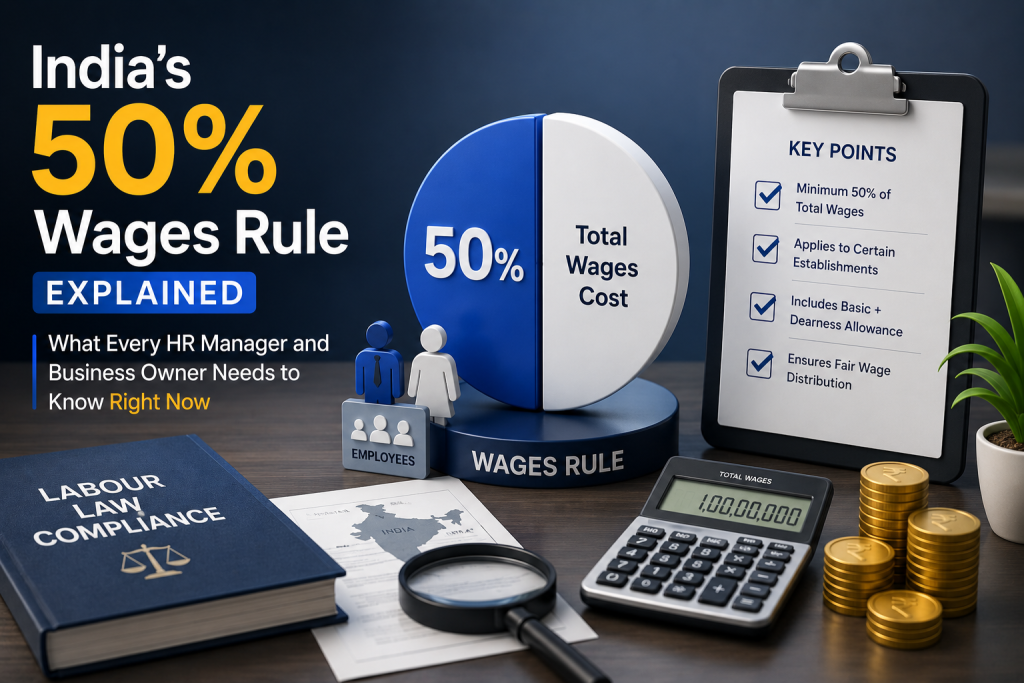
The 50% Wages Rule is a key provision under India’s Code on Wages one of the four new Labour Codes that consolidate 29 old employment laws into a cleaner, simpler framework. The rule states that an employee’s basic wages must be at least 50% of their total Cost to Company (CTC).
Under the new law, “wages” are defined as basic pay, dearness allowance (DA), and retaining allowance combined. All other components of salary HRA, travel allowance, special allowance, food coupons, and any other such additions cannot together exceed 50% of the total CTC. If they do, the excess automatically gets counted as wages for the purpose of calculating statutory dues like PF and gratuity.
In simple terms: you cannot hide most of someone’s salary in allowances to reduce what you contribute toward their retirement and benefits. At least half has to sit in the wage component.
Official source: The four Labour Codes including the Code on Wages were notified by the Ministry of Labour and Employment on 21 November 2025, with enforcement rolling out from April 2026. Since labour is a concurrent subject in India, implementation details vary by state based on when individual states notify their rules.
Why Did This Change Come About?
To understand this, you need to know what was happening before. For years, a very common practice across Indian companies especially in sectors like IT, BFSI, and manufacturing was to design salary structures with an artificially low basic pay. We are talking sometimes 20 to 25% of CTC being the actual basic wage, with the rest split across various allowances.
Why did companies do this? Because PF contributions and gratuity are calculated on the wage component. A lower basic meant lower employer PF contributions, lower gratuity liability, and for employees lower TDS on salary too. It looked good on paper and reduced costs on both sides. But it also meant employees were building far smaller retirement savings than they should have been, and their gratuity payouts were much lower than fair.
The government recognized this as a structural gap in worker protection and used the new Labour Codes to close it. The 50% Wages Rule is essentially that correction.
“What looked like smart salary structuring for two decades was quietly shortchanging millions of Indian employees on their retirement savings and end-of-service benefits. The new rule fixes that but it does come with a cost adjustment for employers.”
How Does the 50% Wages Rule Affect Employees?
For employees, the picture is mixed but mostly positive in the long run.
If your basic salary is already at or above 50% of your CTC, nothing changes for you. But if your company has been running a high-allowance structure which is common your salary will need to be restructured. Your CTC stays the same, but more of it moves into the wage component and less into allowances.
What does that feel like month to month? Your in-hand salary might reduce slightly, because a higher basic wage means higher PF deductions from your own salary too. But here is the thing that money is not gone. It is going into your EPF account, which is yours. Your PF corpus grows faster, your gratuity payout increases, and your financial security at retirement is genuinely stronger.
For employees on fixed-term or contract arrangements, there is another significant change that came alongside this rule gratuity eligibility now kicks in after just one year of service, instead of the earlier five. That is a massive improvement for India’s growing contractual workforce.
What Does It Mean for Employers and Businesses?
This is where the real attention needs to go, especially for HR managers and business owners who are responsible for payroll compliance.
If you have been running salary structures where basic pay was below 50% of CTC, you now need to restructure those salaries. And when you do, your employer PF contribution goes up because it is calculated on the wage base, which is now higher. Your gratuity liability also increases. Your total CTC may stay the same on paper, but your actual cash outflow increases.
For a mid-sized company with 200 employees where basic salaries double under the new structure, the additional annual employer PF cost alone can be significant easily several lakhs per year. That needs to be budgeted for. Finance teams and CFOs who have not already modelled this need to do it immediately.
Non-compliance with the 50% Wages Rule is not just a technical violation it carries retrospective PF liability risk and can attract penalties under the new Labour Codes. If your salary structures have not been reviewed yet, treat this as urgent.
A Real Salary Example Before and After
Let us make this concrete. Take an employee with a total CTC of ₹12,00,000 per year that is ₹1,00,000 per month. Here is what the salary structure looked like before, and what it needs to look like now.
The Direct Impact on PF and Gratuity
These are the two areas where the 50% Wages Rule has the most tangible financial effect both for employees and employers.
Provident Fund (EPF)
EPF contributions are 12% from the employee and 12% from the employer, calculated on PF wages. When basic wages go up, PF contributions go up proportionally every single month. For employees, their EPF corpus grows faster. For employers, the monthly cash outflow increases. There is no way around this if your current salary structures have basic pay below 50%.
Gratuity
Gratuity is calculated as 15 days of wages for each completed year of service. Since wages are now higher under the 50% rule, the gratuity payout on separation is also higher sometimes significantly. Companies that have been provisioning gratuity based on old lower salary structures need to revisit those provisions immediately, especially if they have long-serving employees approaching retirement or separation.
What About Annual Bonuses?
Good question, and one that comes up a lot. Annual performance-based incentives and variable pay do not form part of “wages” for the purpose of statutory calculations under the Labour Codes. This has been clarified by the Ministry of Labour. So your variable pay structure does not get pulled into the 50% wage calculation only the fixed components matter here.
What Should Businesses Do Right Now?
If you have been reading this and feeling a mild sense of urgency that is the right reaction. Here is a practical starting point.
Employer Action Checklist for 50% Wages Rule Compliance
On the point about payroll systems this is worth dwelling on for a moment. The new wage definitions, the 48-hour full-and-final settlement rule, revised PF calculations, updated gratuity provisioning all of this adds real complexity to every payroll cycle. Businesses that are still running payroll on spreadsheets are genuinely exposed, not just to errors but to compliance risk. Good cloud payroll software that is updated to reflect the new Labour Code rules can absorb most of this complexity automatically, so your team is not spending days every month trying to reconcile statutory changes manually.
At Slarify, we have been working closely with businesses across India from growing startups to established companies to help them understand and adapt to the new Labour Code requirements. Based in Kolkata, we know that payroll compliance is not abstract for most business owners. It is a real monthly concern, and getting it wrong has real consequences.
50% Wages Rule: What Changed at a Glance
| Aspect | Before New Labour Codes | After 50% Wage Rule |
|---|---|---|
| Minimum Basic Pay | No minimum often 20–30% of CTC | Minimum 50% of total CTC |
| PF Calculation Base | Calculated on artificially low basic | Calculated on higher, fairer wage base |
| Gratuity Base | Calculated on lower basic + DA only | Calculated on revised higher wage base |
| Contract Employee Gratuity | Eligible only after 5 years | Eligible after 1 year of service |
| Employee Take-Home | Higher short-term (less PF deducted) | Slightly lower month-to-month (more PF) |
| Employee Retirement Corpus | Smaller, underfunded PF savings | Significantly larger over career span |
| Employer PF Cost | Lower (by design of low-basic structures) | Higher but now genuinely compliant |
| Excess Allowance Treatment | No recalculation counted as non-wage | Excess treated as wages for statutory purposes |
Frequently Asked Questions
The four Labour Codes, including the Code on Wages, were officially notified in November 2025 and enforcement began rolling out from April 2026. However, since labour is a concurrent subject under the Indian Constitution, individual states need to notify their own implementing rules. Several states have done so. If your state has notified rules, compliance is immediately applicable. Check your state’s labour department portal or consult a compliance expert to confirm your specific position.
Under the Code on Wages, “wages” includes basic pay, dearness allowance (DA), and retaining allowance. HRA, conveyance allowance, travel allowance, special allowance, overtime, and similar components are not counted as wages for this purpose. The rule says the wage component (basic + DA + retaining allowance) must be at least 50% of the total CTC.
Not necessarily. In most cases, the CTC stays the same but the internal structure changes more in the wage component, less in allowances. However, because employer PF contributions go up (since they are linked to wages), the employer’s actual cost of employing someone may increase even if the CTC is held constant. This is an important distinction for HR and finance teams to understand.
The Code on Wages applies broadly across establishments in India. Small businesses are not automatically exempt. However, applicability thresholds can vary depending on the specific provision and the number of employees. It is advisable for all businesses regardless of size to review their salary structures and seek professional guidance on compliance requirements applicable to them.
No. Annual performance-based bonuses and variable pay are not counted as wages under the Code on Wages. This was clarified in official Ministry of Labour guidance. Only the fixed components of salary are relevant for the 50% wage calculation.
Good cloud payroll software that is updated for the new Labour Code rules can automatically apply the correct wage definitions, calculate revised PF contributions, update gratuity provisions, and ensure your payslips and statutory filings reflect the new requirements accurately. For businesses managing this manually, the risk of errors and non-compliance is much higher especially now that payroll has become structurally more complex.
Under the new Occupational Safety, Health and Working Conditions (OSH) Code, employers must complete the full and final settlement of an employee’s dues within 48 hours of their last working day whether they resigned or were terminated. This is now a legal requirement, not just good practice. It makes automated payroll processing even more critical, since manual F&F calculations within 48 hours are practically very difficult to do accurately.